Performance
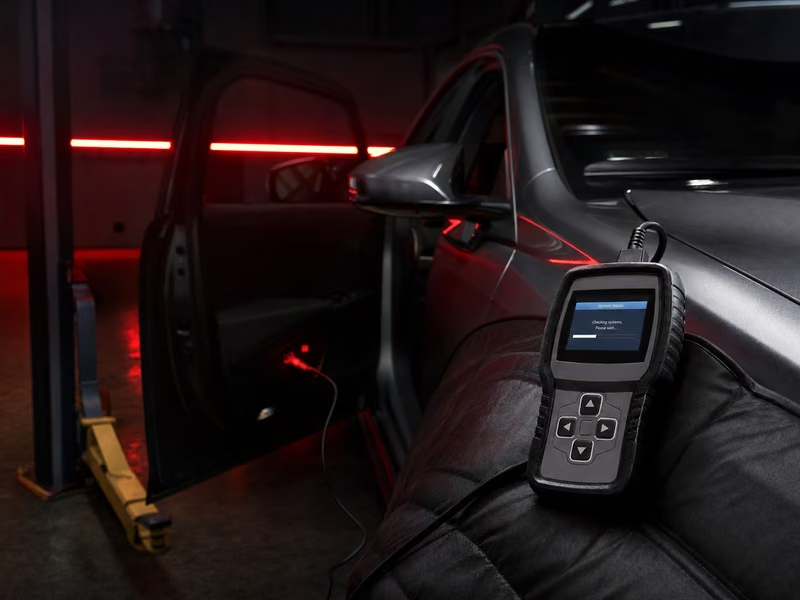
Diagnostics
£40–50

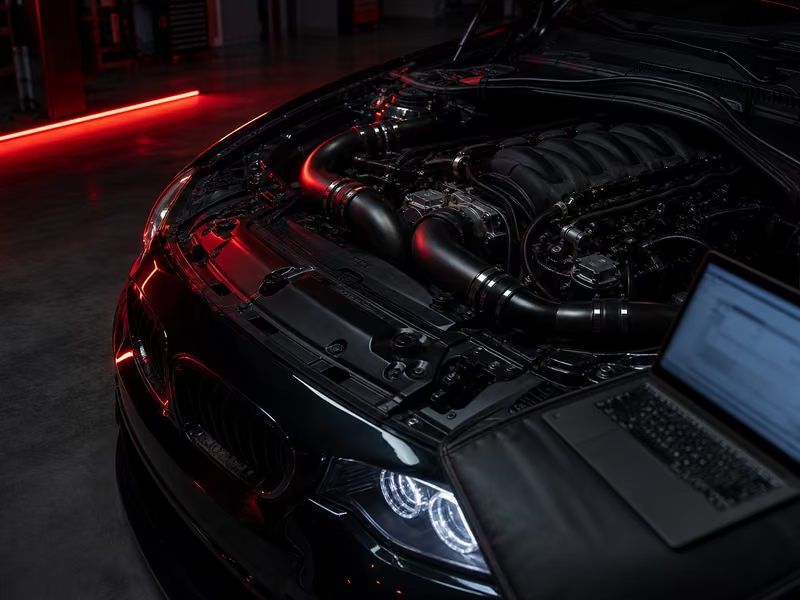
Performance
A DPF delete is a software change to how the ECU treats the diesel particulate filter, and it is off-road, motorsport or export work only. On a road car, a blocked or failing DPF needs cleaning, repairing or replacing instead.

The diesel particulate filter traps soot in the exhaust and burns it off periodically in a cycle called a regeneration. When regens keep failing, the filter fills up, and the ECU responds with a warning light and often limp mode to protect the engine.
A delete is a recalibration so the ECU no longer manages or monitors that filter. It is software only. The filter itself stays bolted into the exhaust, which describes the work and nothing more. It is not a reason the vehicle would pass anything, and it has no bearing on whether the vehicle can be used on the road.
Nothing about it unblocks a filter or repairs a regen fault. The blockage is still in the exhaust; the ECU has stopped reporting it. So we only do it on vehicles that are not driven on public roads.
Motorsport and track vehicles kept off public roads, off-road machinery, and vehicles being exported where different rules apply. We will ask which of those describes your vehicle before we agree to anything.
The people who most often ask are not in that group. They are running a road car doing short journeys that never get hot enough to complete a regen, with a warning light that keeps coming back and a quote for a new filter. For that car, the road-legal routes are a forced regen, a clean, or a replacement filter, and a diagnostics check tells you which of them is actually needed.
Knowing which one applies matters before you decide. A DPF light can come from a sensor or a pressure pipe rather than the filter, and replacing an expensive part that was never the problem is a bad afternoon.
The first conversation is about the vehicle and how it is used, and it is a real gate rather than a formality. If what you describe is a car that lives on the road, we will say so and talk about the repair options instead.
We run a diagnostics check before anything is written. If the car has a fault, tuning on top of it hides the fault rather than fixing it, so we deal with that first or we don't proceed.
The calibration is written on dealer-level tools, with nothing unbolted from the vehicle at any stage. It is then run and checked before the vehicle goes back to you, because writing a file and proving it on the car are two different things.
Every job runs on a 100-amp battery support unit. Voltage dropping mid-write is how ECUs get bricked, and it is the single most common way a cheap remap goes wrong.
You can have a USB backup of your original file, so the car can be put back to how it left the factory whenever you want.
Everything is done at our own unit at 85 Bogmoor Road in Glasgow, directly across from the Shieldhall test centre. ECU work belongs in a workshop with the vehicle on a battery support unit, so it is not something we take out to a driveway.
The work is done by an IMI-approved technician trained by The OBD Company, on dealer-level tools rather than a generic cable.
We would rather diagnose your DPF problem than assume it. Plenty of the cars that arrive here with a DPF light have a sensor fault, a stuck regen or a driving pattern behind it, and those have answers that keep the car road legal. Send the registration and what the dash is doing and we will tell you what we think it is.
No. It is offered strictly for off-road, motorsport or export vehicles. For a car used on public roads we would look at cleaning, repairing or replacing the filter instead.
Removing or disabling emissions equipment is not road legal in the UK, and the MOT includes emissions checks. Keeping a vehicle compliant is the owner's responsibility, and this work does not help with it.
No. It is a software change and the filter stays where it is. That describes the work and nothing more. It does not alter where the vehicle can legally be used.
A DPF needs a completed regeneration cycle to clear itself, and stop-start driving often never gets there. A diagnostics check will show whether it is the filter, a sensor or the regen cycle itself, and that decides between a forced regen, a clean and a replacement.
Yes, if you have the USB backup of your original file. Putting it back leaves the ECU as it was when the vehicle left the factory.
Yes, start with diagnostics. Limp mode is the ECU protecting the engine from something it has logged, and reading that code is the first useful step whatever you decide afterwards.
Next step
Tell us what you drive and what you want done to it. We will come back with a price for your car, not a range off a chart.