Security
No Fob No Start
£550

Cameras and sensors
Parking sensors, front, rear or both. They are set into the bumper and colour-matched so they look like they came with the car, then set up so the warning reaches you while you still have room to do something about it.
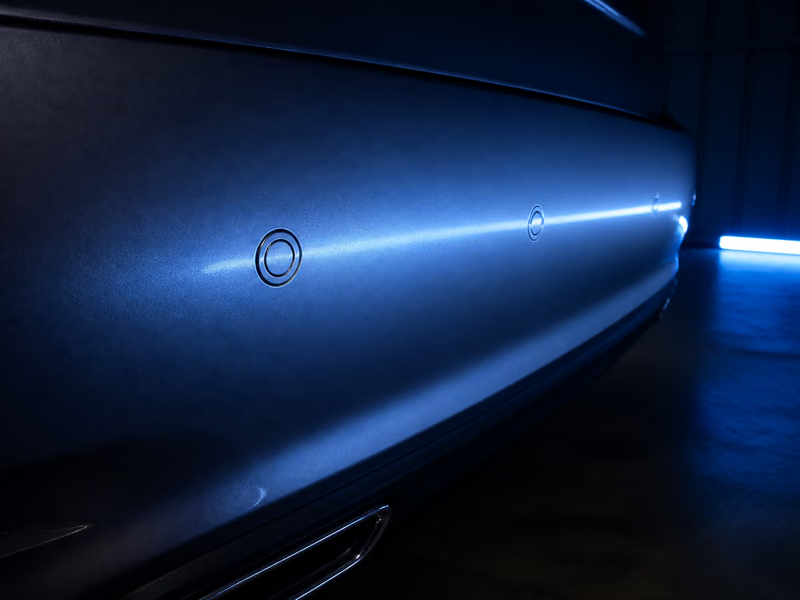
Ultrasonic sensors set into the bumper, wired to a control box and to a warning inside the car. As you approach something the tone quickens, and it becomes continuous once you are close. It is a simple idea and it works because it needs no attention: you do not have to look at anything.
Rear only is the common fit and answers most of the problem. Front and rear is what people choose on longer vehicles, on anything with a nose they cannot see over, and on cars parked nightly in tight spaces where the wall in front is as much of a risk as the one behind.
The sensors are colour-matched to the bumper. That is a fitting decision rather than a cosmetic afterthought: four unpainted grey discs in a painted bumper are the reason a lot of people never fit them at all.
Anyone driving something bigger than their last car. The single most common reason this job gets booked is a change of vehicle, when the distances someone has judged by eye for years stop being right.
Vans and pickups, where the back of the vehicle is a long way from the driver and there is often nothing to judge it by. Sensors and a reverse camera together are the usual answer, because they solve different halves of the problem.
Drivers of older cars that never had them. Parking sensors are one of the few modern conveniences that can be added to an older vehicle properly, rather than approximated with something stuck to the dashboard.
Sensors have to be positioned and set at the correct height and spacing, because that is what decides whether they warn you about a bollard or about the road surface. Too low and the sensors read the ground on a slope; badly spaced and there is a gap between them that a post fits neatly into.
They are set into the bumper rather than stuck onto it, and colour-matched. Then the wiring runs inside the vehicle to the control box and to the warning, so nothing is visible from outside except the sensor faces themselves.
The work is done by an IMI-approved technician trained by The OBD Company, on dealer-level tools rather than a generic cable.
Before you leave, we test them against a real obstacle at real distances rather than trusting that a beep is a beep. That is the check that catches an aim or height problem while the car is still with us.
Fitting sensors means going into a bumper, and doing that properly is the difference between a job that looks factory and one that looks like an accessory. It is done at our own unit at 85 Bogmoor Road in Glasgow, across from the Shieldhall test centre, with the vehicle properly supported.
The wiring is the same discipline the security side of this workshop applies to every install: inside the vehicle, behind trim, nothing hanging where it can be pulled.
We will tell you whether front sensors are worth it on your vehicle or whether rear alone answers the problem. There is no reason to sell you eight sensors for a car that needs four.
Yes. The sensors are colour-matched to the bumper as part of the fit, so they read as part of the car rather than as something added to it.
Rear alone answers most of the problem and is the common fit. Front and rear is worth it on longer vehicles, on anything with a nose you cannot see over, and if you park nightly somewhere tight at both ends. Tell us the vehicle and where you park it and we will give you a straight answer.
They can, but a tow bar sits in the sensors' field and has to be accounted for when they are positioned and set up. Tell us it is there before the day, because it changes where the sensors go.
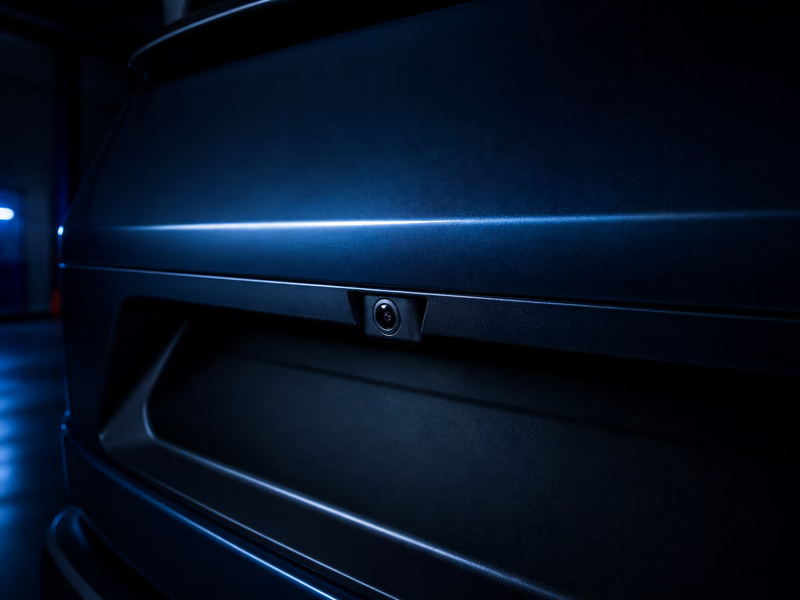
Yes, and the two work well together. The sensors tell you how close something is, including things below a camera's view; the camera shows you what it actually is. Fitted on the same visit rather than as two jobs.
It depends on the vehicle and on whether you want front, rear or both, so there is no figure on this page. Tell us what you drive and what you want and we will price it.
Next step
Tell us what you drive and what you want done to it. We will come back with a price for your car, not a range off a chart.