
Security
ScorpionTrack explained
ScorpionTrack is a British-made tracking range, and the names in it are easy to mix up. Here is what each part does, which bit your insurer actually cares about, and what to check before you pay.
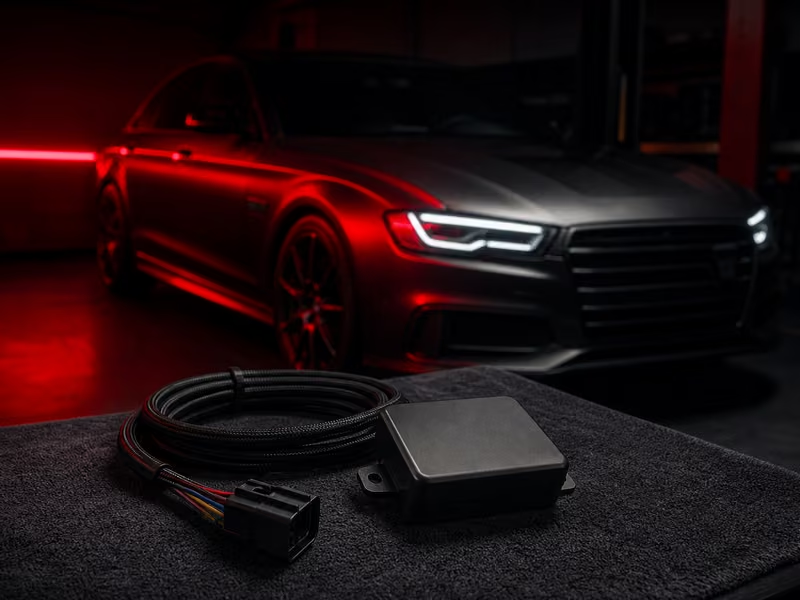
People ring us and ask for “a Scorpion tracker”. Almost always they have been handed the name by an insurer, a broker or someone at work whose car has one. What nobody hands them is which product in the range they are supposed to be buying, or what it does that a cheap tracker off a marketplace site does not.
Here is the plain version.
Who makes it
ScorpionTrack is made by Scorpion Automotive Ltd, a British manufacturer based in Chorley in Lancashire. ScorpionTrack is the name for their tracking and monitoring products.
The same company also makes the X-Series immobiliser, which is the unit we fit when somebody asks us for a ghost immobiliser. People mix the two up constantly, so let us separate them now. The immobiliser tries to stop the car being driven away, and the tracker deals with what happens if one is. Same manufacturer, different job, different product, different price. Buying one does not give you the other.
The range, and the part your insurer reads
Most of the muddle comes from several products in the range sounding alike.
ScorpionTrack S7 ALS is an asset location system. A concealed unit is wired into the vehicle and reports its position to a monitoring centre. If the car is taken, you tell the monitoring centre and they work with the police to locate and recover it. There is nothing to carry and nothing to remember. This sits in the Thatcham S7 category.
ScorpionTrack S5 VTS does everything the S7 does and adds automatic driver recognition, shortened to ADR. You carry a small tag. When the car moves with a tag present, the system reads that as you driving. When it moves without one, the system reads that as a theft happening right now, and the monitoring centre is alerted before anybody has looked out of a window. This sits in the Thatcham S5 category.
Quantum3 is a battery-powered unit at S7. Because it does not take its power from the vehicle, it suits things that are not a car in the usual sense. Plant, trailers, and vehicles where running a wiring loom is not wanted or not sensible.
There is also a Defender range. If a quote puts that name in front of you, ask which Thatcham category the specific model carries. Product names change over time. Categories are the stable thing, and the category is what an insurer is reading.
Which one you actually need
Read the wording your insurer sent you, because it is the whole answer.
If the policy names S5, fit S5, and an S7 will not do instead. If it names S7, fit S7, because fitting S5 is not wrong but you are paying for something nobody asked you for. If it just says “a tracker” with no category attached, ring and ask which one they mean, and get the answer in writing while you have them on the phone.
A Thatcham category meets the tracker requirement set by most insurers, but requirements are written per insurer and not centrally, so check your own policy rather than trusting a general rule. Thatcham says the same thing itself.
If nobody has asked you to fit anything and you are doing it because you want to, the question changes shape. S5 raises the alarm while the car is being taken. S7 makes the car findable afterwards for less money. Decide which of those two you are buying before you look at prices.
What “authorised installer” means here
Scorpion’s dealer network is application-based. A garage applies, gets assessed and gets trained, and Scorpion decides. We are an installer for it.
Two honest limits on how much that tells you.
There is no public installer map to check anybody against. If a garage tells you it is an authorised installer, you cannot look that up on Scorpion’s website in the way you can with some other trades. Asking the manufacturer directly is the only real check, and very few customers ever do.
Thatcham certifies the equipment and nothing else. It does not run an approved-installer scheme and it does not certify garages, so nobody anywhere is a “Thatcham-approved installer” no matter what a website says. What can fairly be claimed is that the system is Thatcham-certified and that the person fitting it is trained and competent.
The certificate and the subscription
After the system is fitted and tested with the monitoring centre, Scorpion issues an Install Certificate. It reaches you by email from the platform rather than being handed over at the counter, which catches people out.
That certificate is the document your insurer wants, and it only exists once the system has been proven to report. A unit that has been screwed into a car and never tested live is not a finished job.
The monitoring is a subscription, and the cover depends on it staying live. If the subscription lapses, the requirement your insurer set is no longer being met, and insurers do check that at claim time rather than at renewal. Put the renewal date somewhere you will see it. This is the most common way a good system quietly stops being any use.
What actually happens if the car goes
Worth knowing before you buy, because the product only makes sense once you can picture this.
The car moves. On an S5 system with no tag present, the monitoring centre sees that immediately and rings you to check it is not you. On an S7 system, the first move comes from you: you notice the car has gone and you ring them. Either way, from that point the process is the same.
The monitoring centre has live position data and works with the police, who are the only people who go anywhere near the vehicle. You do not chase your own car. People do try, and it goes badly often enough that every monitoring centre in the country will tell you not to.
The gap between those two starting points is the whole reason S5 costs more than S7. Overnight, it can be the difference between a phone call while the car is still moving and finding out at breakfast. A car goes a long way while a household is asleep.
The app is a useful thing to have and most owners check it, but it is not the product. The monitoring centre is the product. A tracker you watch yourself on a phone is a different and much cheaper category of thing, and it is not what an insurer means.
What to ask before you pay
Four questions, and any competent fitter will answer all four without hesitating.
- Which exact unit is going in, and which Thatcham category does it carry?
- Will it be tested live with the monitoring centre before I drive away?
- Who issues the certificate, and where does it get emailed?
- When does the subscription renew, and what happens if I miss it?
If a quote will not name the unit, it is not really a quote. Any tracker sold with no Thatcham category attached is answering a different question, and while there are perfectly decent uncertified trackers for keeping an eye on a vehicle, they will not satisfy an insurer and should never be sold as though they might.
The strongest setup on a car that sits outside overnight is a covert immobiliser and a Thatcham-certified tracker working together, because one of them argues with the thief and the other one deals with the aftermath. We would rather explain that than sell you half of it and let you assume you are covered.
Common questions
Is ScorpionTrack Thatcham-certified?
The relevant units in the range hold Thatcham categories, and the category is stated per product rather than across the whole brand. Ask which category the exact unit being quoted carries, and check that it matches the category named on your policy.
What is the difference between S5 VTS and S7 ALS?
S7 ALS is monitored location. S5 VTS adds automatic driver recognition tags, so a car moving with no tag present is treated as a theft in progress and the monitoring centre is alerted straight away. S5 is the one insurers tend to name on higher-value cars.
Can I fit a ScorpionTrack myself?
No. It is a monitored product that has to be installed, registered with the platform and tested live before the certificate exists. A unit bought and wired in at home is not a system an insurer will accept.
Do I need the app?
The app is useful and most people use it, but the cover does not depend on you watching a screen. The monitoring centre is the part that matters. Treat the app as convenience rather than as the product.
What happens to it when I change cars?
In most cases the unit comes out of the old car, goes into the new one and gets re-registered with the platform. That costs less than buying a whole new system, so tell us before you sell rather than after.
Next step
Let's get you a price
Tell us what you drive and what you want done to it. We will come back with a price for your car, not a range off a chart.