
Security
What a ghost immobiliser actually is, and what we fit
A ghost immobiliser stops a car being driven away without a PIN entered on its own buttons. Here is how they work, what they do not do, and which one we fit.
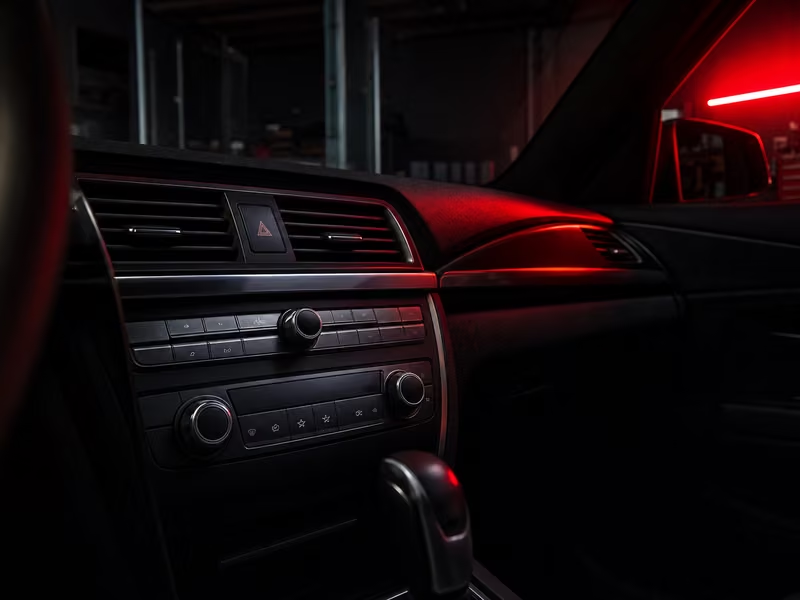
If you have been reading about stopping your car being stolen, you have run into the phrase “ghost immobiliser” and probably not found a straight explanation of what one is. Here is one.
What the thing actually does
Every modern car has an internal network its computers talk over, called the CAN bus. A ghost immobiliser is a small unit wired into that network. It listens, and until it sees a PIN sequence it recognises, it will not let the car be driven away.
You enter that sequence on buttons the car already has: the steering wheel controls, the window switches, the climate buttons. You pick the combination yourself, up to about twenty presses. Nothing extra is fitted to the dashboard. No keypad, no key fob, no little red LED blinking on the centre console.
That last part is the whole design. Anything a thief can see is something a thief can work around. Someone sitting in your car with a cloned key sees an entirely standard interior and a car that will not move.
Why this exists now
Car theft changed. Breaking a lock or hot-wiring the ignition is no longer the easy route into a modern car.
The easy route is the key. A relay attack uses two people and two devices: one stands near your front door picking up the signal from the key on the hall table, the other stands by the car repeating it. The car believes the key is present. It unlocks, it starts, and it is gone, with no damage and often no noise.
Key cloning is the same idea with more preparation. Either way, the thief ends up with something the car accepts as your key.
An immobiliser like this makes that insufficient. The signal gets them into the car and it gets the engine running. It does not get them a PIN sequence they have no way of knowing.
Where the name comes from, and what we fit
“Ghost” began as one manufacturer’s product name for a device of this type. It caught on, and it has become the word people use for the whole category, in the same way people ask for a Hoover when they want a vacuum cleaner.
So when someone rings up asking for a ghost immobiliser, what they are almost always describing is the type of system rather than one company’s box.
We fit the Scorpion X-Series, made by Scorpion Automotive in Chorley. It is covert, it works over the CAN bus, and it uses a PIN sequence on the car’s own buttons, with no fobs and no LEDs. Our page for it still carries the word “ghost”, because it is the word you will have searched for. We would rather name the unit going into your car up front than let you find out afterwards.
What it will not do
This matters more than the list of what it will do, because the gap is where people get caught out.
It is not a tracker. Determined thieves will put a car on a low-loader, and an immobiliser has nothing to say about that. Recovery is a tracker’s job.
It will not satisfy an insurer asking for a tracker. When a policy sets a security requirement, it names a Thatcham category, and those categories cover tracking products. An immobiliser is a different product and does not meet a requirement written for a tracker, however good it is. Read the wording your insurer sent you and fit what it names.
It does not interfere with the car while you are driving. It has done its job before you pull away, and nothing about it can stop a moving car. The system is built that way on purpose.
It is not a substitute for locking your car. Obvious, but it still needs saying.
Living with one
The real cost is a couple of seconds. You get in, you enter your sequence, you drive. After a fortnight you stop noticing it, in the same way you stopped noticing your phone’s passcode.
Two things to think about when you choose the sequence. Make it something you can do in the dark, in the rain, with a child shouting in the back. This is not the moment for elegance. And do not use a pattern anyone watching from the passenger seat would pick up in one go.
Service mode covers the garage and the valet: someone can drive the car without your sequence and without the system being switched off for good.
Is it right for your car?
The cars being taken this way are the ones with a resale market: newer VW, Audi, BMW and Mercedes, performance models, and almost anything with keyless entry. If your car is on that list and it sits on a driveway overnight, this is a reasonable thing to be thinking about.
If your car is not, and nobody has asked you to fit anything, you may be solving a problem you do not have. We would rather tell you that than sell you a box.
The strongest setup is an immobiliser and a Thatcham-certified tracker together. We sell them as a pair for that reason, rather than pretending either one covers the whole problem.
Common questions
Is a ghost immobiliser worth it if I already have a tracker?
They do different jobs, and fitted together they are stronger than either alone. An immobiliser tries to stop the car leaving at all; a tracker deals with what happens if one does. If you only ever fit one, fit whichever your insurer asked for.
Can a thief find it and unplug it?
There is nothing visible to find. It is installed covertly and communicates over the car's own data network rather than through a cut wire, so there is no keypad, no LED and no fob pointing at it.
What happens if I forget my PIN sequence?
You go back to whoever fitted it and they reset it. You will not need the car recovered, but it cannot be sorted over the phone either.
Will it work with a valet or a garage?
Yes. There is a service mode that lets someone drive the car without knowing your sequence, and it does not disable the system permanently.
Does it drain the battery?
The draw is very small and comparable to the car's own systems. On a car that sits unused for months you would want a battery conditioner anyway, immobiliser or not.
Next step
Let's get you a price
Tell us what you drive and what you want done to it. We will come back with a price for your car, not a range off a chart.